⚖️ Choosing the Right Business Structure in Kenya: Sole Proprietor, Partnership, or Company
·

⚖️ Choosing the Right Business Structure in Kenya: Sole Proprietor, Partnership, or Company
Meta description: A plain-English guide to Kenya’s sole proprietorships, partnerships, and limited companies with official links for formation, tax, and compliance.
🧭 Introduction: Why your structure matters
Picking a business structure is not just paperwork. It affects your personal risk, taxes, compliance workload, investor readiness, and how you can grow or exit. In Kenya, the common options are the sole proprietorship, partnership, and limited company. All are registered and managed through the Business Registration Service (BRS) on eCitizen. See the framework here: BRS site and the Business Registration Service Act, 2015 (PDF).

💡 Key takeaway: Your legal form shapes your risk, taxes, and growth path. Choose it deliberately.
🗺️ Overview of the main structures in Kenya
Quick snapshot
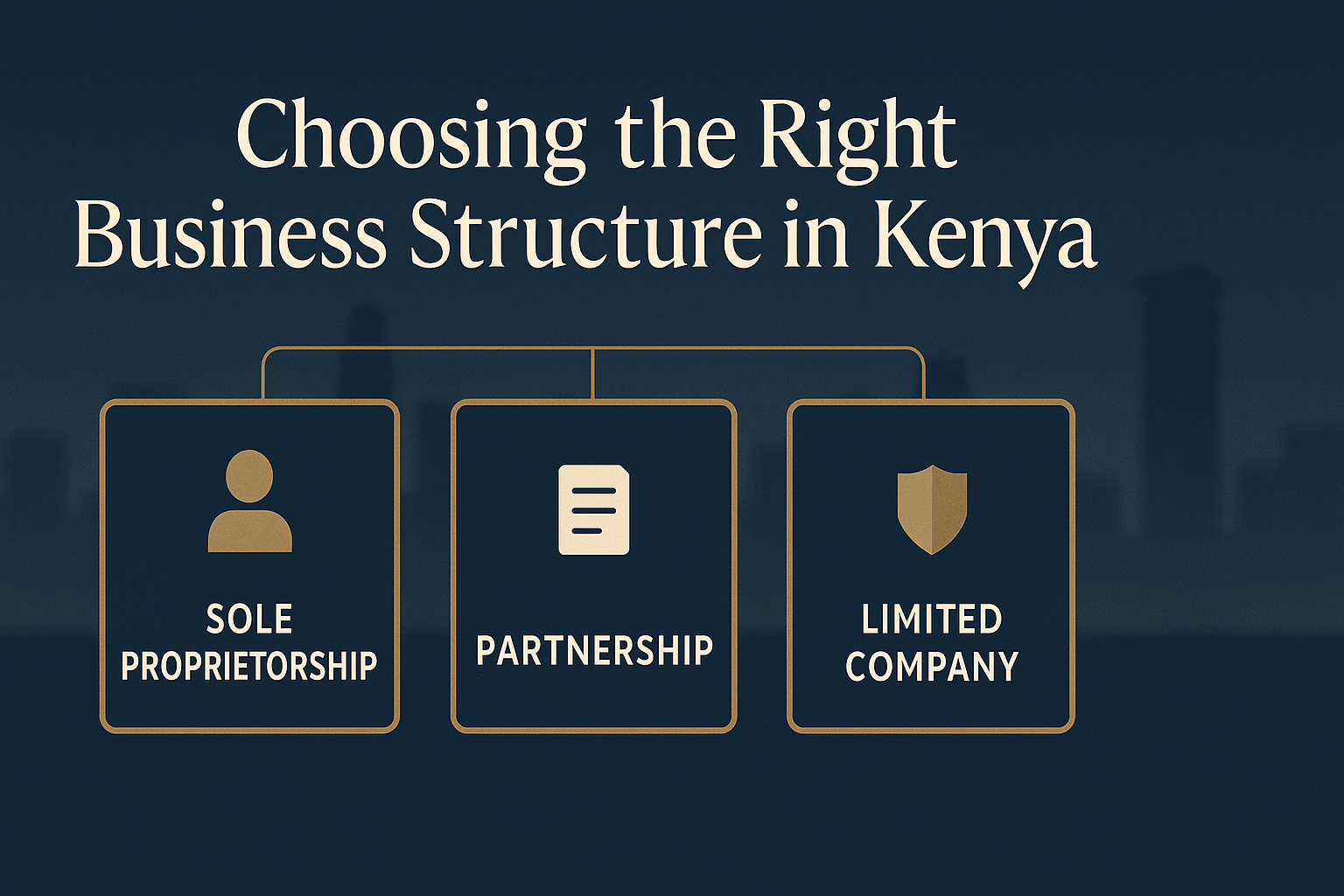
- Limited company (Ltd): Separate legal person with limited liability under the Companies Act, 2015. Stronger governance and better investment readiness. Act text: Companies Act, 2015.
- Sole proprietorship: Registered as a Business Name on eCitizen. No separate legal personality. Lowest cost and simplest setup, but the owner carries full personal risk. Costs and basics appear in the BRS FAQ: BRS FAQs (PDF).
- Partnership: Two or more persons carry on business together under the Partnerships Act, 2012. In a general partnership, partners share responsibility and risk. Act text: Partnerships Act, 2012.
💡 Key takeaway: Sole prop is simple, partnership shares control and risk, company provides limited liability and is better for scale.
🧑💼 Sole Proprietorship
Legal status: Not separate from owner
Liability: Unlimited personal liability
Tax: Personal income or Turnover Tax if eligible
Good for: Fast start, side hustles, low risk
🤝 Partnership
Legal status: Partners operate together. Consider LLP for limited liability.
Liability: Joint and several in a general partnership
Tax: Profits taxed in partners’ hands
Good for: Professional teams with strong trust
🏢 Limited Company
Legal status: Separate legal person
Liability: Limited for shareholders. Directors have statutory duties.
Tax: Corporation tax. Dividends and salaries are separate
Good for: Growth, investment, governance
🧩 Sole Proprietorship – when simple and fast is enough
What it is
A sole proprietorship is a business owned and run by one person. It is usually registered as a Business Name via BRS on eCitizen. There is no separate legal personality. You and the business are the same in law. See: BRS FAQs (PDF).
Liability and ownership
You have unlimited personal liability for business debts and obligations. There is no shareholder shield.
Tax
Your business income is taxed as personal income under the Income Tax Act (Cap 470). If eligible, you may pay Turnover Tax under section 12C. Check the thresholds and current rules in KRA’s consolidated document and the Act text: KRA Income Tax Act (PDF) and Cap 470 online view.
Compliance
Keep basic books, file your personal returns with business income, and maintain applicable licences such as KRA PIN, VAT if required, and county permits. Registration and updates go through BRS: BRS site.
When it fits
Freelancers, micro retail, and test-phase ventures where speed and low cost matter more than risk shielding.
💡 Key takeaway: Easiest to start, but your personal assets are exposed if things go wrong.
🤝 Partnership – shared ownership and shared risk
What it is
A partnership is two or more people doing business together under the Partnerships Act, 2012. Register the firm name through BRS. Unless you choose an LLP, partners in a general partnership are typically jointly and severally liable for firm debts. See: Partnerships Act, 2012.
Liability and ownership
Each partner can bind the firm in the ordinary course of business. A strong partnership deed is essential. It should set profit shares, decision-making rules, admission and exit of partners, and dispute resolution.
Tax
Partnerships are generally tax transparent. Profits are allocated to partners and taxed in their hands under Cap 470: Cap 470 online view.
Compliance
Maintain proper accounts, file returns consistent with partner shares, maintain licences, and update BRS when partners or details change: BRS site.
When it fits
Professional practices and small teams with high trust. If liability is a concern, consider a Limited Liability Partnership (LLP) for limited liability with partnership-style management.
💡 Key takeaway: Flexible for teams, but protect yourselves with a solid deed or opt for an LLP to reduce personal risk.
🏢 Limited Company – separate legal person built for growth
What it is
A private limited company is incorporated under the Companies Act, 2015, creating a separate legal person that can own property, contract, sue, and be sued. Act text: Companies Act, 2015.
Liability and governance
Shareholders’ liability is usually limited to any unpaid amounts on their shares. Directors owe statutory duties such as acting in good faith to promote the success of the company and avoiding conflicts of interest. Breaches can lead to remedies and, in serious cases, personal exposure. See the Act: Companies Act, 2015.
Kenyan courts also allow derivative actions by shareholders for wrongs done to the company. See Ghelani Metals Ltd and others v Elesh Ghelani Natwarlal [2017]
Lifting the corporate veil
Limited liability is strong, but it is not absolute. Kenyan courts may pierce the corporate veil for fraud, abuse, or to prevent injustice. See Ong’au and another v Mukunya [2015]: judgment and Kenagen Contractors Kenya Ltd v Abogno [2024]: judgment.
Tax
Companies pay corporation tax under Cap 470, with separate treatment for dividends and director remuneration. See the Act here: Cap 470 online view.
Compliance
Expect annual returns, statutory registers including beneficial ownership, board and shareholder resolutions, and timely BRS filings through eCitizen. Official portal: BRS site.
When it fits
If you need investor credibility, share-based incentives, limited liability, or clean succession and exit paths, a company is usually best.
💡 Key takeaway: A company gives limited liability and governance discipline, which is ideal for growth-minded businesses.
🧪 Taxes at a glance – what founders usually ask
Personal versus corporate
- Sole prop or partnership: taxed in the owner’s or partners’ hands under Cap 470.
- Company: pays corporation tax. Owner returns may arise through salary or dividends.
💡 Key takeaway: Run the numbers before deciding. The lowest tax route depends on margins, how you pay yourself, and Turnover Tax eligibility.
🧱 Compliance – what you will actually do each year
BRS filings: Maintain registers, file annual returns, and update beneficial ownership for companies. Keep partnership and Business Name particulars current.
KRA obligations: File income tax returns and any other applicable taxes such as VAT, PAYE, and withholding tax.
Licences: Sector and county permits based on your trade.

💡 Key takeaway: Create a compliance calendar for BRS and KRA dates. Small delays can become costly.
⚖️ How Kenyan courts shape real-world risk
Two areas matter most for founders.
- Director accountability and shareholder remedies: Kenyan courts recognise derivative actions under the Companies Act. Shareholders can seek permission to sue in the company’s name for wrongs to the company. Read Ghelani Metals [2017]: judgment.
- Piercing the corporate veil: Courts can set aside limited liability to prevent abuse. See Ong’au v Mukunya [2015]: judgment and Kenagen Contractors [2024]: judgment.
💡 Key takeaway: Limited liability protects honest business. It does not shield fraud or abuse.
Free Business Structure Checklist
Decide faster with a 2 minute step guide that helps you make the best business decision.
Download the PDF🛠️ Practical tips before you choose
Risk tolerance: If you handle higher-risk contracts or inventory, consider an LLP or a company for liability protection.
Growth plan: Investors, employee share plans, and clean exits work more smoothly in a company. Shareholder remedies and director duties provide governance discipline.
Documentation quality: For partnerships, insist on a strong partnership deed. For companies, use a shareholders’ agreement alongside Articles.
Budget and cost: Expect a low entry cost for a Business Name and higher costs for companies depending on share capital and filings.
💡 Key takeaway: Match structure to risk, growth, and admin capacity. Then document it properly.

🚀 Conclusion – choose with the end in mind
- Choose a sole proprietorship for speed and simplicity if the risk is low.
- Choose a partnership for small, trust-based teams and use a strong deed, or consider an LLP to reduce personal exposure.
- Choose a limited company for scale, investment, and governance.
When you are ready to register or to transition from one structure to another, get tailored advice on tax impact, asset transfer, licences, and stakeholder agreements. Consult Herman Tambo Law Advocates for tailored advice on business setup and compliance in Kenya.
FAQ’s
⚠️ Legal Disclaimer:
This article is general information for Kenya as of November 10th, 2025, not legal or tax advice, and reading it does not create an advocate–client relationship; for tailored guidance, contact Herman Tambo Law Advocates to book a consultation.
Ready to discuss your legal needs?
Get the clarity and guidance you need. I am here to help you navigate your legal journey with confidence.